V · Commercial processes · Chapter 17
Inventory, purchasing, manufacturing, quality and PLM
The structure of product data, stock moves, the purchasing chain, manufacturing, quality management (nonconformity, 8D, AQL, calibration) and the product life cycle.
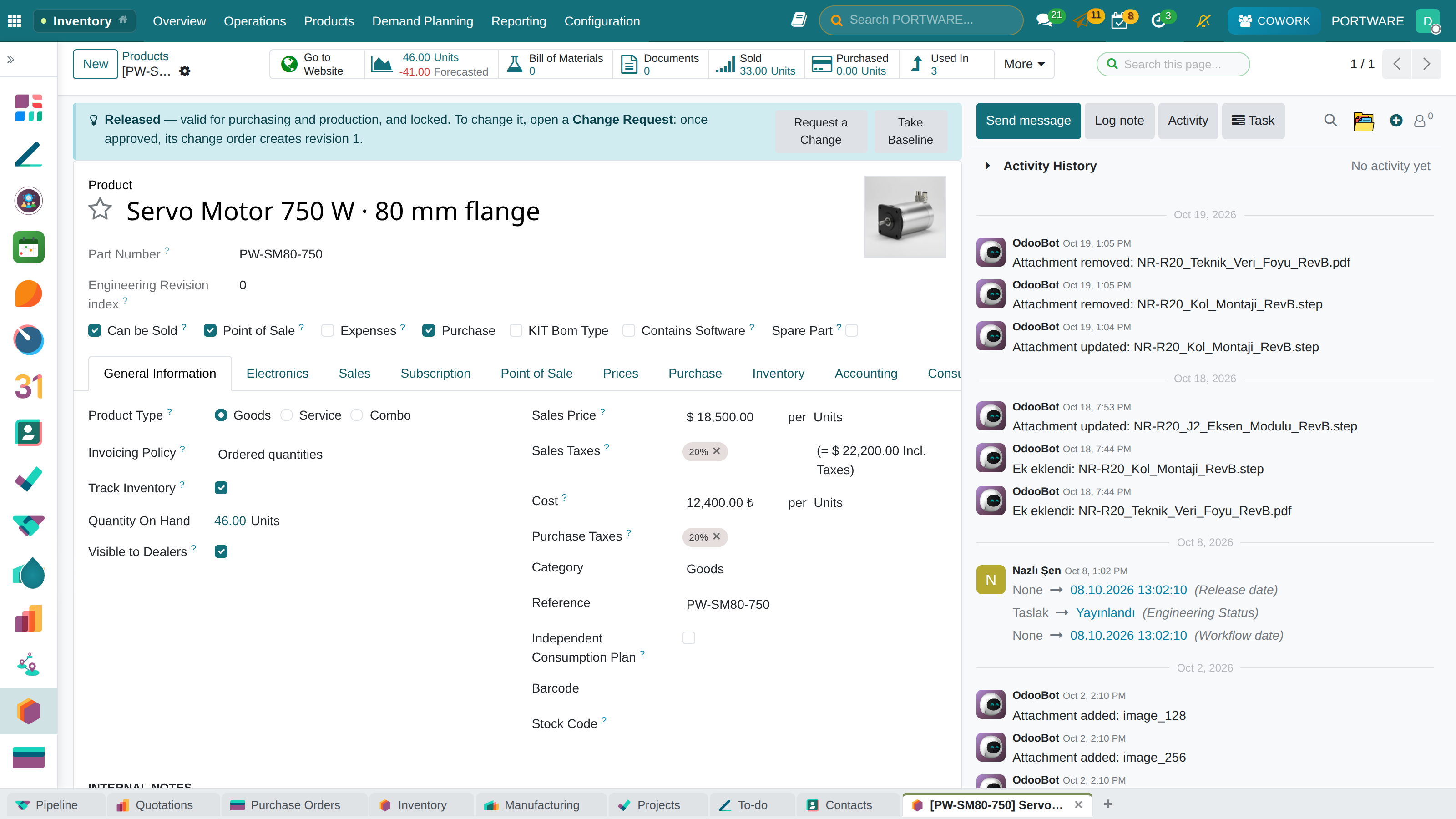
Product: template and variant
A product sits on two levels. The template carries what is common (name, category, description, technical notes); the variant is the concrete thing that is sold (a specific combination of attributes such as colour, power or voltage). Stock moves and prices are at variant level.
In this system product data is mostly technical: values such as torque, voltage class, encoder type, communication protocol and temperature range sit not as free text but in separate fields. The reason is simple — the website, the selection guide and comparison tables read the same value. A torque value written into free text cannot be calculated with anywhere.
Inventory
Stock is not a quantity field but moves. The quantity you have is the result of all receipts and issues up to that day. That is why "correcting" a quantity by hand is not the right way; an inventory count is made and the system writes the difference as a move.
The basic operations:
| Operation | What it does |
|---|---|
| Receipt | Accepting goods coming from purchasing |
| Delivery | Goods going out to the customer |
| Internal transfer | Moves between warehouses/locations |
| Inventory count | Matching the system with a physical count |
Barcode support can be used both on the sales/purchase side and on the picking screens; EAN13 barcodes can be generated for products.
Purchasing
The chain is the mirror image of sales: request → request for quotation → purchase order → goods receipt → vendor bill.
Vendor prices are defined on the product; if a product has no vendor price, cost calculations and the below-cost warning (chapter 16) do not work meaningfully. The morning briefing lists products with missing prices every day (chapter 15).
Manufacturing
Manufacturing runs through the bill of materials (BOM) and work orders. What a product is made of and with which operations is defined in the bill of materials; the work order takes that definition to the shop floor.
PLM — the product life cycle
The PLM package carries the engineering side and consists of 32 modules. The highlights:
- CAD integration — the link between drawings and the system.
- Engineering bill of materials and BOM comparison.
- Revision management — which revision is valid; sales, purchasing and manufacturing see only the latest revision.
- Spare-part trees and manuals.
- 3D viewing — the model is examined by rotating it inside the system.
- Automatic weight calculation, automatic engineering code, file conversion.
Quality management
Quality runs inside the warehouse and manufacturing; no data is moved to a separate system. The inspection itself is done with the quality control modules (tests, questions, triggers, inspections); PORTWARE adds what comes after the inspection: when a defect is found, who owns it, why it happened, what was done with the product and whether the correction worked.
Nonconformity and 8D
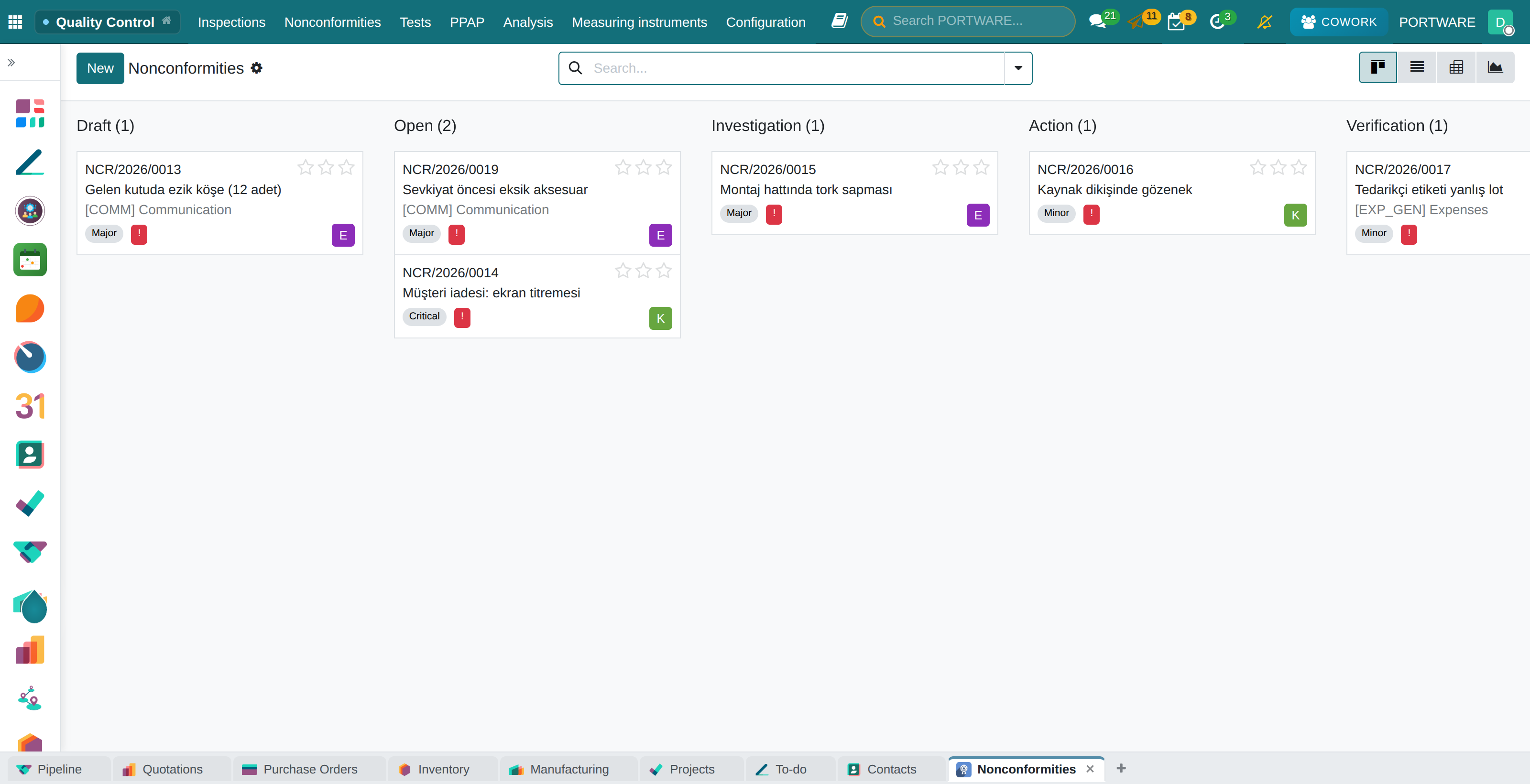
Quality Control › Nonconformities. An internal nonconformity (NCR), a supplier corrective action request (SCAR), a customer complaint and an audit finding are one record type; they follow the same path:
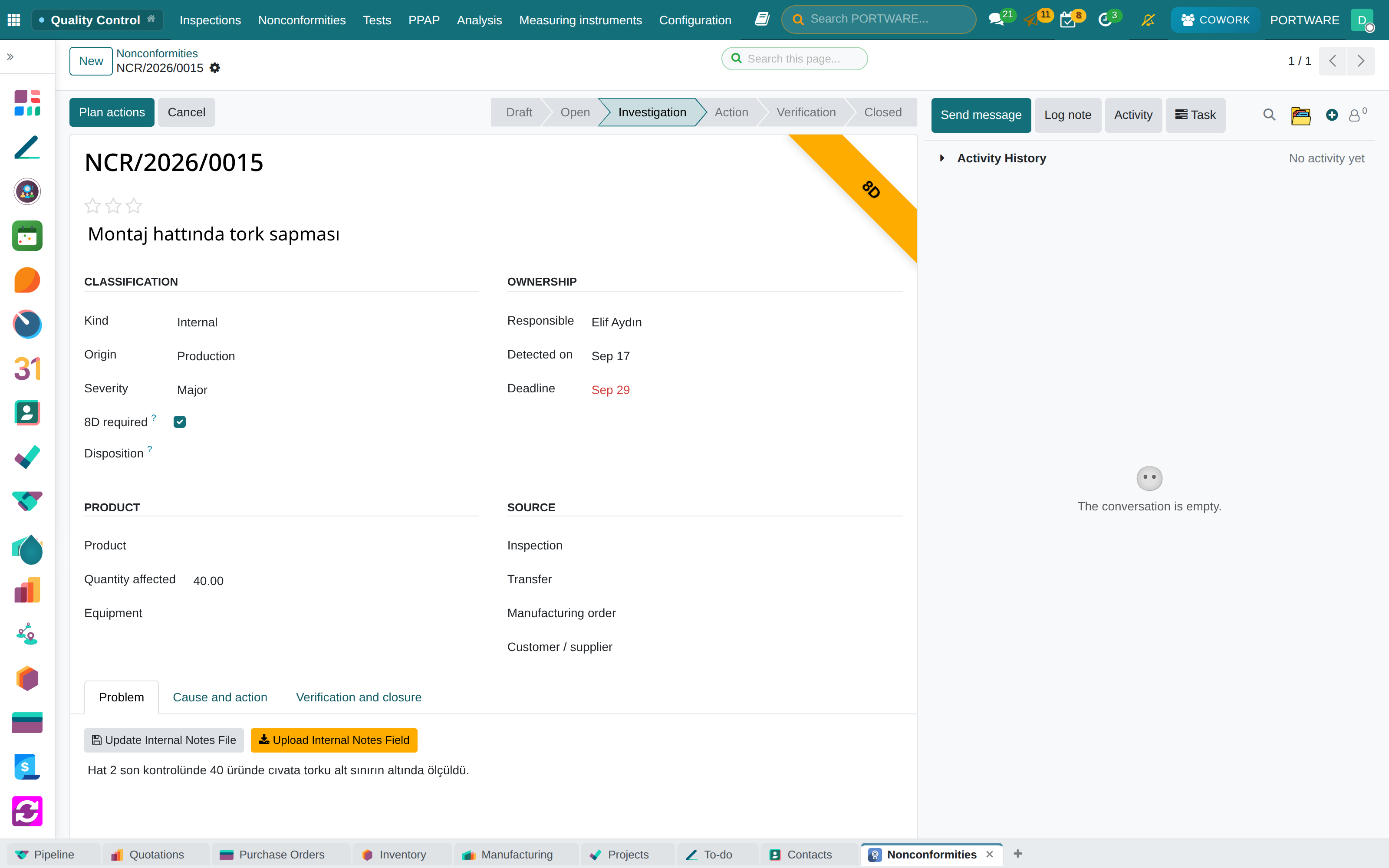
Draft → Open → Investigation → Action → Verification → Closed
Every transition has a condition, and the condition is checked on the button itself:
- Opening needs a person responsible; a dated activity lands on them.
- Planning an action needs a root-cause category (6M: man, machine, method, material, measurement, environment — plus design) and a root-cause text. An action whose cause is not written treats the symptom.
- Moving to verification needs a written corrective action.
- Closing is the quality manager's job alone and is not possible without the product decision (use as is, rework, repair, scrap, return to supplier…), the root cause, the corrective action and a signed effectiveness check.
A major/critical nonconformity and every customer-originated record is an 8D: closing it also requires a team (D1), a containment action (D3) and a preventive action (D7). The 8D ribbon in the corner of the form says so.
A nonconformity can be opened by hand, but its main path is this: a failed inspection opens its own nonconformity and assigns it to a person. Transfer, manufacturing order and inspection forms have a Report nonconformity button; products, partners and transfers have a counter — a supplier's history shows on its card.
Sampling and frequency
Sampling is chosen separately for each test: every unit, a fixed quantity or ISO 2859-1 (AQL; tables I and II-A, with the arrows resolved). For each trigger line the frequency: every time, random % or periodic. For quantitative questions the measured value is recorded; a pass/fail question can hold the measurement too, so "0" and "empty" are told apart.
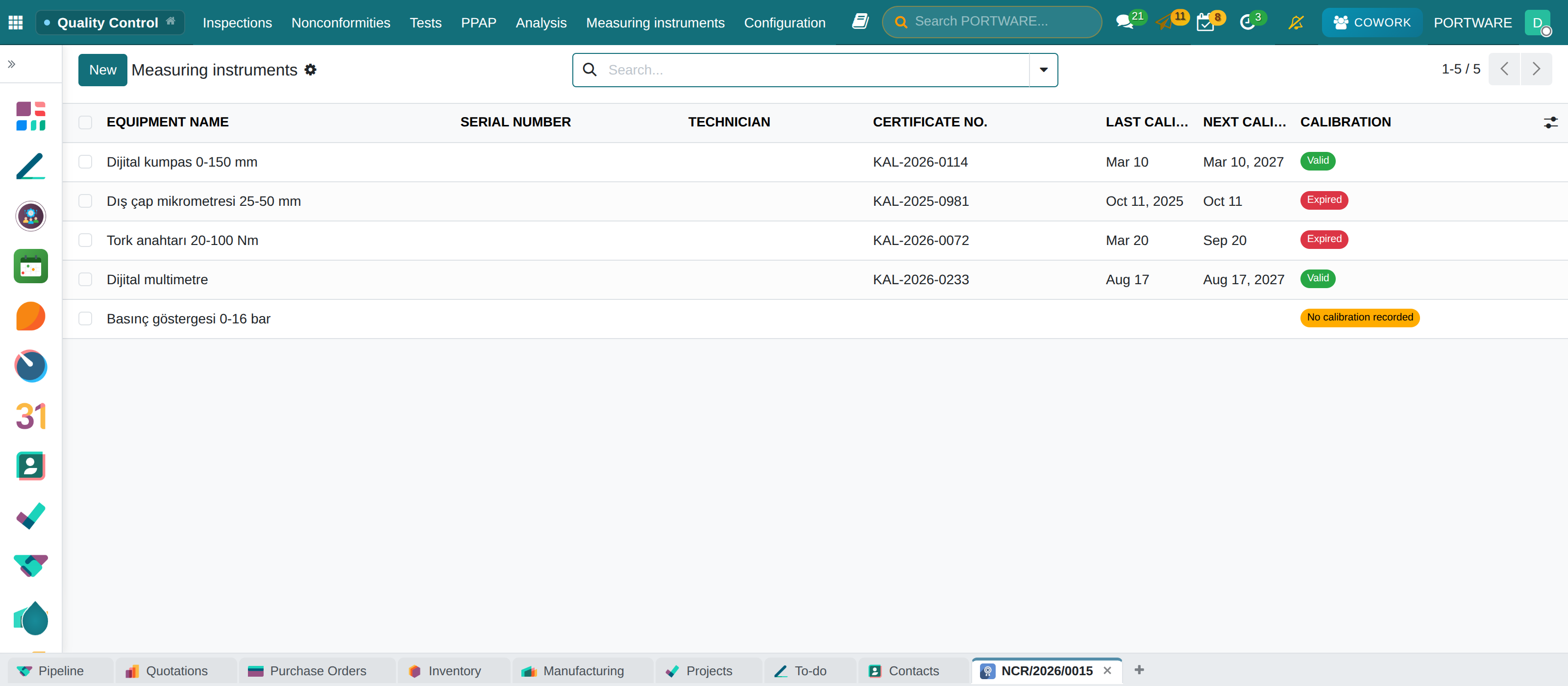
Measuring instruments and calibration
Quality Control › Measuring devices. Every instrument that makes an accept/reject decision is kept as a maintenance equipment; the calibration interval (months), last calibration, certificate number and file and the laboratory are on the card. The status is computed: Valid, Due soon, Expired, No record. Noticing that measurements were taken with an expired instrument is no longer left to the auditor.
Analysis
Quality Control › Analysis gives three reports: inspection analysis (pass rate, supplier, product), defect Pareto (which question fails most) and nonconformity analysis (type, source, root cause, duration).
Product descriptions
A product description serves two separate jobs in two separate places: the sales description that goes to the customer and the technical note used internally. When the two are mixed up, either the customer sees internal information or the quotation goes out with missing information.
Internal notes carry a version history (chapter 4) and can also be backed up and restored by hand — so that there is a point to return to if a bulk edit goes wrong.