V · Commercial processes · Chapter 22
Finance III — OKR: from objective to key result
Objective, key result, check-in and confidence; an objective setting the scorecard's target.
Finance › OKR. This is the only part of the Finance application open to every employee. Someone without a finance group sees only this when they open the application; the scorecard and financial statements stay hidden.
The reason is a design decision: objectives should be visible, financial statements should not.
Glossary
| Term | Meaning |
|---|---|
| Cycle | The period in which OKRs are written and scored (for example 2027Q1) |
| Objective | What we want to achieve — qualitative; its level can be Company / Team / Individual |
| Key Result | How we will know we reached the objective — quantitative |
| Check-in | A figure + a sentence + confidence |
| Confidence | On track / At risk / Off track |
| Alignment | Which objective serves which |
Menu: OKR › My Objectives · Alignment · All Objectives · Key Results · Check-ins · Cycles. The last menu is for the OKR manager only.
Types of key result
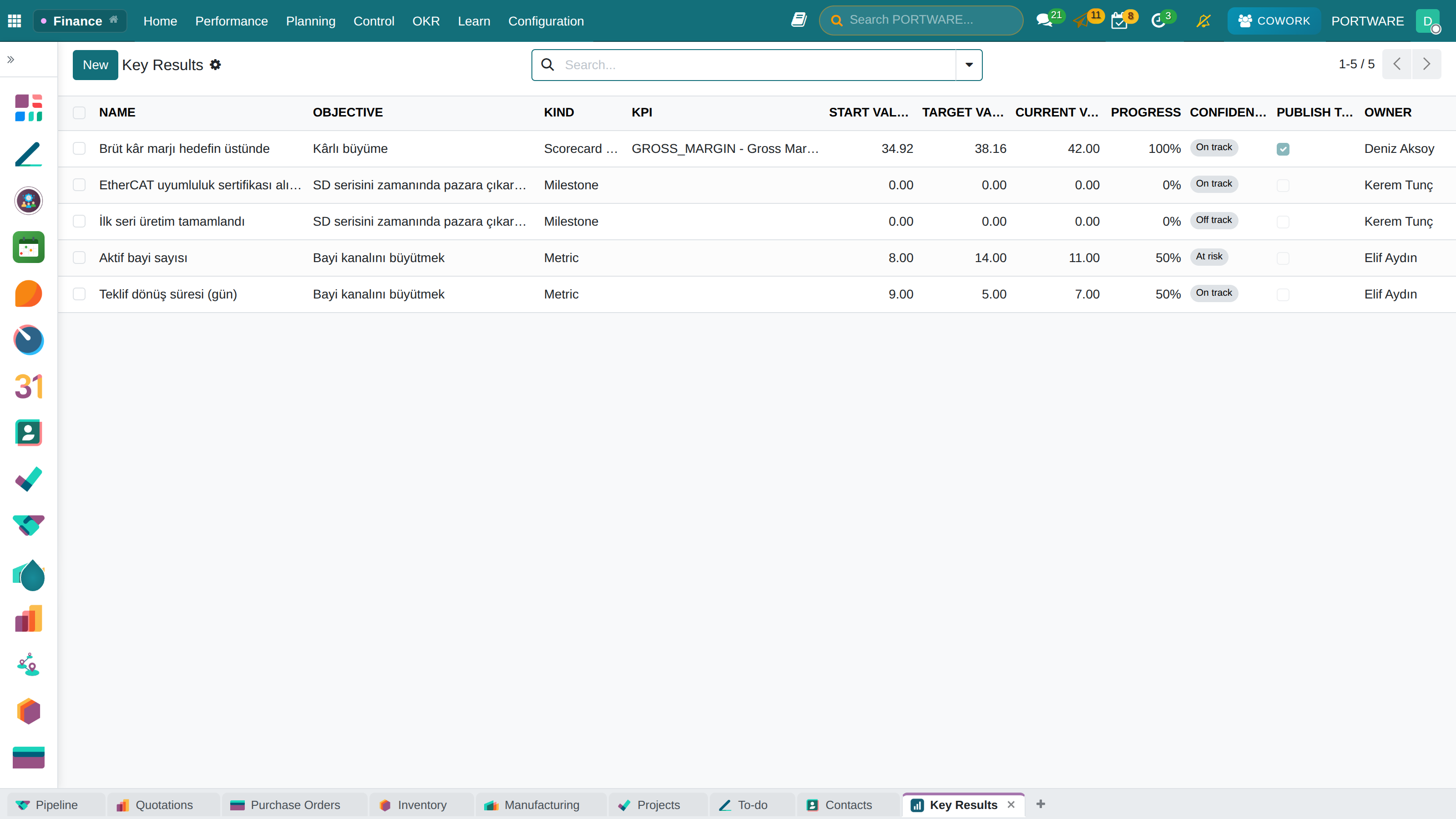
- Metric — a number entered by hand.
- Milestone — done / not done.
- Scorecard KPI — its value is read from the scorecard and cannot be entered by hand.
The third ties OKR to the measure registry of chapter 20: the objective's measure is the very figure the rest of the company reads. There is no "OKR figure" kept in a separate table, updated by hand and drifting away from the main figure over time.
Progress and confidence
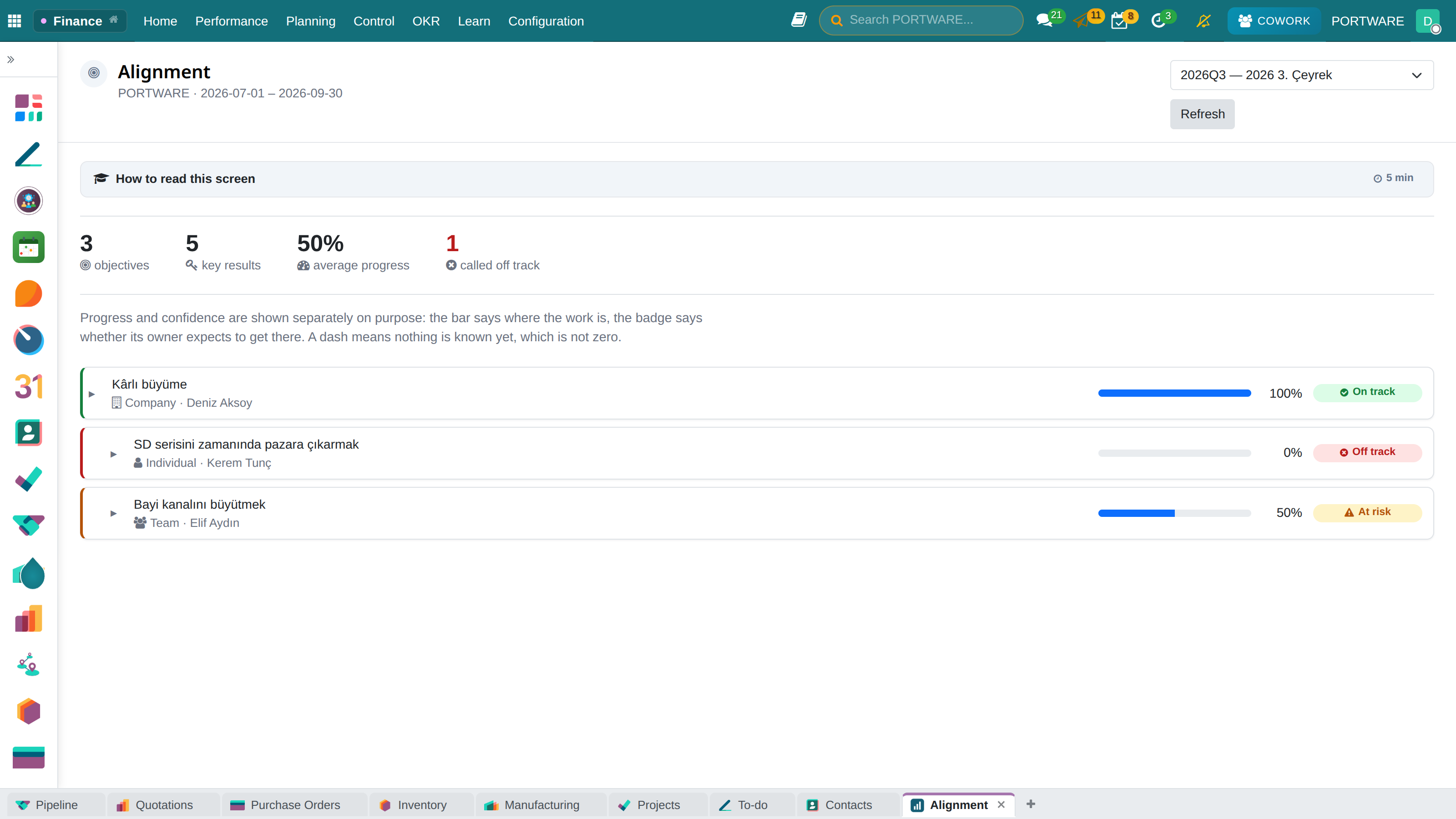
Progress is computed, confidence is written. Progress says where you are, confidence says whether you will get there. The system does not derive one from the other — if it did, OKR's only early warning would be lost. 20% progress in the second week is normal; if the owner says "Off track", that is a reason for a meeting.
On the alignment board the two are shown separately too: the bar carries progress, the badge carries confidence.
The rules of the progress calculation:
- If higher is better:
(now − start) / (target − start), between 0% and 100%. - If lower is better: the reverse.
- If target = start, progress is undefined — not 100%.
- A KPI with no reading is undefined — not 0%.
- An objective's progress is the weighted average of its key results; undefined ones do not enter the average.
- A parent objective does not average its children's progress.
- An objective's confidence is the worst of its key results. Not the average: three pieces of good news are not allowed to soften one bad one.
These rules are OKR's version of the "undefined ≠ zero" principle of chapter 20. Counting a key result that has not been measured yet as 0% produces the picture of a team that is not working, and leads to the wrong meeting.
The flow of a quarter
OKR manager: OKR › Cycles › New → 2027Q1 → Activate.
Management writes 3–5 company objectives.
Teams write team objectives that serve a company objective (by filling in the Parent field).
2–4 key results are added to each objective.
A weekly Check in: value + sentence + confidence.
OKR › Alignment shows the whole tree and the risks on one screen.
At the end of the quarter, Close and score.
Closing a cycle scores and freezes every objective and key result. A closed cycle cannot be reopened — history is not evidence if it can be corrected later.
The system does not rule on "is 0.7 a success?". The answer depends on whether the objective was a stretch, and that is the company's decision, not the system's.
End to end: a nine-step story
An example that brings the three finance chapters together in one flow:
- The Readiness screen: what is missing?
- OKR: the company objective "profitable growth in 2027"; key result Gross Profit Margin ≥ 35% — a Scorecard KPI with its target published.
- Scorecard: Gross Profit Margin is now coloured against this target.
- Budget: the 2027 base budget; the sales line with the driver
UNITS * PRICE, expenses by hand. Submit → approve. - Control: policy Warn; a purchase order creates an overrun and appears in Budget Overruns.
- Month end: Plan / actual in the grid, an explanation written for the red variance.
- Cash: the 13-week panel; payroll and tax outflows entered by hand.
- Revision: the scenario changed → a new version, v2 approval.
- Quarter end: OKR scoring.
The difference between KPI and OKR
They are confused so often that it is worth writing separately:
- A KPI measures health and is watched constantly — like blood pressure.
- An OKR aims at change and is periodic — like a training programme.
Your blood pressure is always measured; your training programme changes every three months. In a well-built system an OKR sets a KPI's target — in PORTWARE this is called Publish Target.
Summary of this chapter
- OKR is open to every employee; financial statements are not.
- A key result is quantitative; the Scorecard KPI type ties it to the company's real figure.
- Progress is computed, confidence is written — and the system does not derive one from the other.
- A result not yet measured is undefined, not zero.
- A closed cycle is not reopened.