V · Commercial processes · Chapter 18
HR, payroll and field service
The employee record, time off, payroll, document tracking, recruitment and managing work in the field.
The employee record
Every user has an employee record (chapter 3), and it is at the centre of the HR side: identity details, department, manager, contract, contact, documents.
Time off
A time-off request comes from the employee, the manager approves it and it goes onto the calendar. The balance is followed per leave type. Approved leave affects the person's availability — it is visible when planning meetings.
Payroll
The payroll package covers salary structures, payslips and their conversion into accounting entries. For the Turkish legal side, see chapter 19.
In addition:
- Employee loans and their accounting entries.
- Document validity tracking — the expiry dates of documents such as a driving licence, a certificate or a medical report are followed and a warning is produced before they expire.
- Resignation/leaving process — the steps for a leaving employee are followed.
Timesheets
Time spent comes in two ways:
- When closing an activity — the hours spent are entered as the job is finished and become a timesheet line (chapter 5).
- Automatically from meetings — the duration of a meeting in the calendar can be written to the attendees' timesheets.
The second is a small but effective gain: time spent in meetings is usually never recorded, and projects look cheaper than they really are.
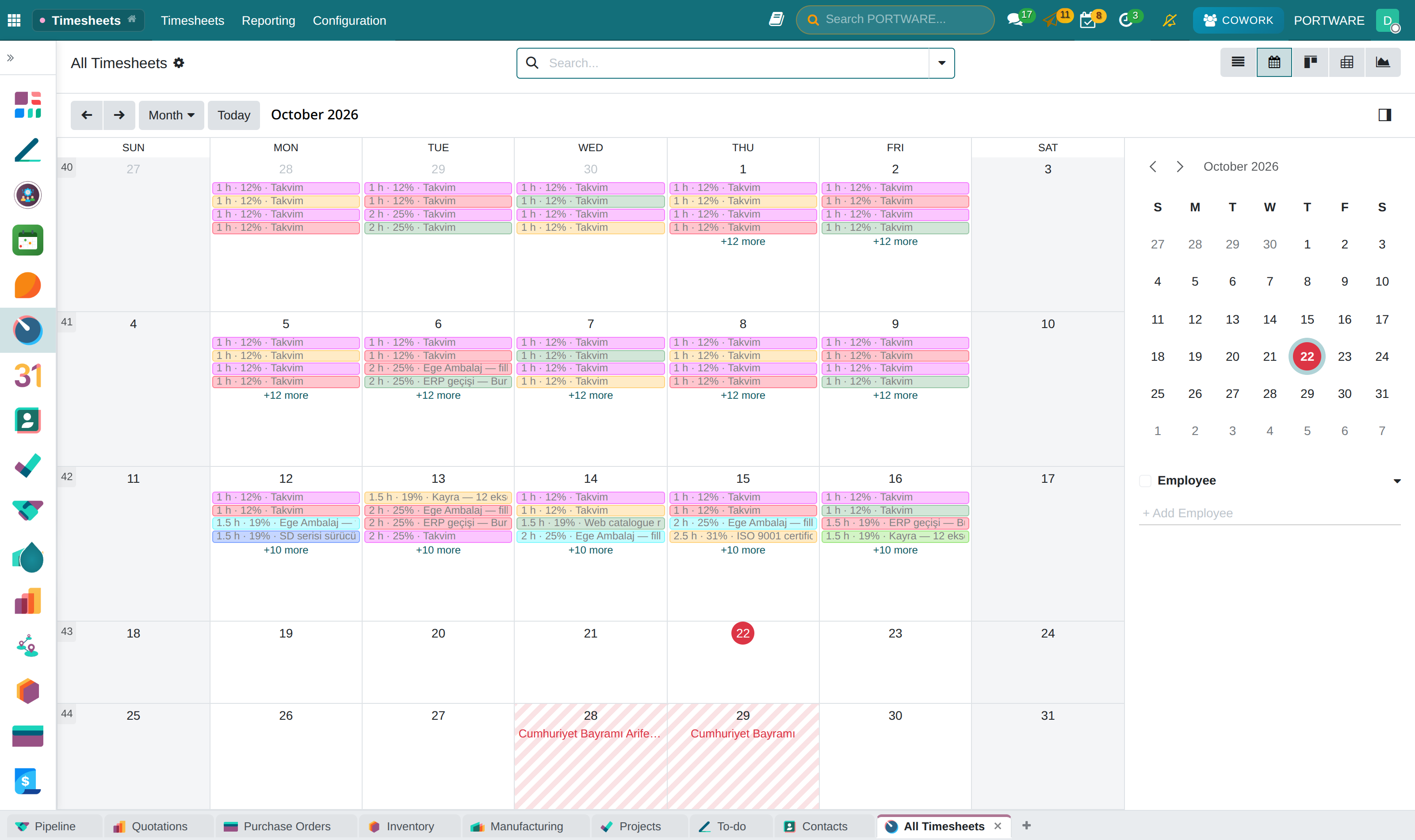
A colour per person. In the timesheet calendar every employee appears in their own colour; the colour is chosen on the employee card. The initial values are spread so that the colours are as far apart as possible, and nobody's chosen colour is overwritten. The legend in the side panel shows the same colour as the events.
Public holidays. Holidays are marked on the calendar in their own colour and with their name (chapter 26). In the All Timesheets list the Excluding Public Holidays filter hides the holiday lines written automatically for everyone — so that they do not crowd the view when you look at real work. The calendar's scale (day / week / month) is changed with the button at the top.
Recruitment
Job posts, applications, stages and interview tracking. Applications are records too: they have their own conversation stream, attachments (the CV) and activities. CV PDFs are indexed by content, so they can be searched by a technology named in them (chapter 13).
Field service
The field service package manages work done at the customer's site: the work order, planning, crew assignment, materials used and time spent.
The chain is:
Request/Fault → Field work order → Planning and assignment → On-site work → InvoicingWork done in the field leaving a trace in the system serves two things: what was done can be proven to the customer, and repeated faults on the same product can be seen.
A recurring fault
- Situation
- A similar fault was reported at the same customer for the third time.
- What was done
- The customer's field work orders were listed and grouped by product.
- Result
- All three work orders turned out to be in the same product family; the issue stopped being a service problem and became a product/installation question. This link could not have been made if the work orders had not been kept as records.
Meetings and HR
Most HR processes move forward through a meeting: interview, appraisal, disciplinary talk. Remember that a meeting has two note fields and different people read them (chapter 5) — an interview note going to the candidate is a mistake that is hard to undo.